Thursday, November 17, 2005

The Science of Aurora Borealis

WHAT ARE NORTHERN LIGHTS?
The
surface of the sun is constantly burning and erupting with prominences (pictured below). When these large "loops" completely break off they are called solar flares which cause a radioactive stream of these sun charged particles to go into the universe. As this solar wind of charged electrical particles enters the Earth's atmosphere, they are pulled to the magnetic North and South poles, which is why they are called either the Northern or Southern Lights, depending on where you see them.
The charged particles cause our
planet's oxygen and nitrogen atoms to glow, causing what astronomers call an Aurora.


When is the best time to see them and where?

Depending on the amount of particles in the solar wind, Auroras can be seen regularly in north Alaska at Fairbanks (200 nights a year) ,at Anchorage (100 nights), less than 100 nights in southern Canada, and less than 50 nights in the northern tier states. Viewers may see the Aurora in the deep southern states once
every 10-30 years. When a region is experiencing the effects of the Aurora, they can be viewed from sunset to sunrise, for a few seconds to several hours, varying in color, shape, and brightness. The weather must also be clear and the viewer must be away from city lights to see the Aurora.


A KP map shows the level of solar activity necessary to see an Aurora in your area. If you live in Canada above the blue band, a solar storm with a KP3 value would be needed for you to see an Aurora. The further south you go in North America, the larger the solar storm needed to see the Northern Lights. For instance, if you were a member of the Twin Cities Northern Lights Hockey Team which plays in Minneapolis Minnesota, you would live in the green band; you probably would not see Auroras caused by a KP3 storm but you would with a KP5 storm, especially if it was clear night and you got away from the city lights. People in St. Louis however would rarely see an Aurora because it would take a KP9 storm (which is relativey rare).


Radiation Storm:
In 2000, astronomers recorded a solar radiation storm. The sun is in the middle of the frame. You can see the eruptions coming from the surface of the sun, sending the charged particles into the universe, some of which came to Earth.


What causes the different colors?

When Oxygen atoms (60-100 miles from the Earth's surface) are hit by these charged particles of solar wind, they
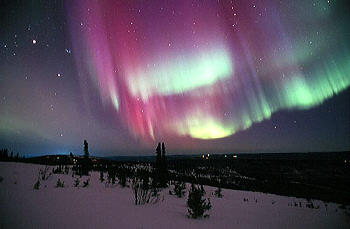
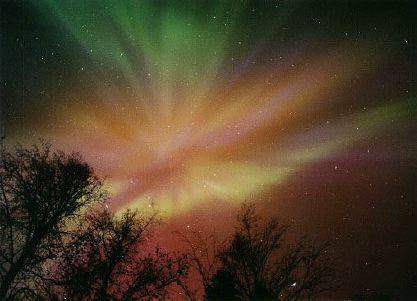
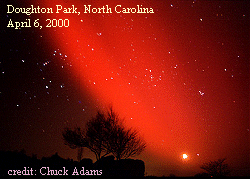
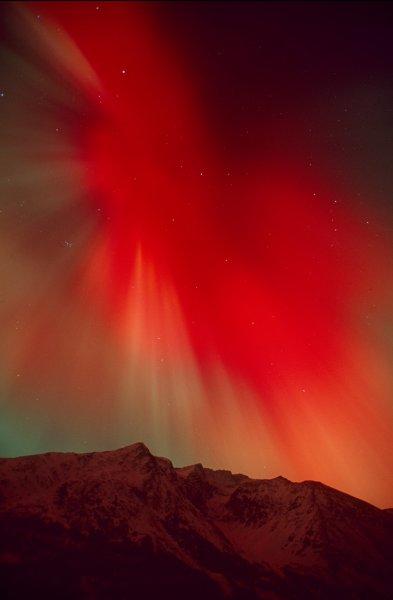
glow green, green-white, and green-yellow. These are the most common colors you will see. Oxygen atoms that are 100-150 miles away will glow a deep red and this is the most rare color scheme. Nitrogen atoms close to earth grow blue or violet, and turn more pink the further away from our planet they are.

.
.

Contrary to popular legend, the temperature has nothing to do with their colors because the temperature in the void of space is the same at both heights
.


What causes the various shapes?

The Earth's magnetic field lines draw the glowing atoms into arcs, bands,
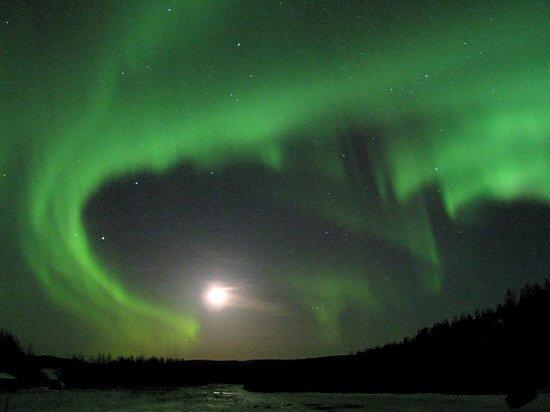
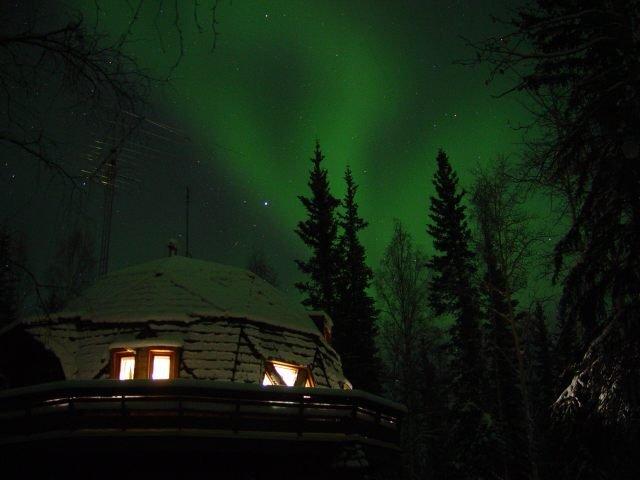
rays, pillars, draperies, and crowns (coronas). Look at the pictures and see what kind of shapes you see!

What effects does the Aurora have on Earth?
The glowing particles never touch the ground, hanging in the atmosphere at least 60 miles away from Earth to the larger Auroras being measured as far as 600 miles away from the surface. Because of the curve of the horizon, it appears as though the Aurora bends to touch the ground, but they do not. With this solar radiation, the Aurora has a dramatic effect on power systems, radar, radio communications, navigational tools, and satellite signals (why your satellite tv may get fuzzy reception!) Astronauts who are in space during these burst of solar radiation must be careful to take protective measures.

Monday, August 01, 2005

More Photos

Behind the Scenes: It was this colors in this photo that made up select our hockey team's colors! That's why our colors are navy, teal, and silver on a white jersey.


Do you see the monster that's about to eat the moon?!